The end of the yearly budget race is now in the sights of the lawmakers as the leadership teams of both houses were able to come to an agreement on where they wanted to budget to fall out, does that include the expansion of Medicaid, let's review the activities of the week.
House:
The House Health Policy committee this week took testimony on a host of legislation. House Bill 4736 which would bring Expedited Partner Therapy to Michigan, that could make it the 36th state to put this policy into place. Dr. Annette Mercatante, health officer of St. Clair County Health Department, testified on behalf of MSMS and the Michigan Association of Local Public Health. Dr. Mercatante was able to provide the experiences of those working in the public health field and those working in the local public health departments. Dr. Jody Jones testified on behalf of ACOG providing the aspects of pregnant mothers and their unborn children. The committee also considered Senate bills 237, 238, and 239 that would change immunization requirements by having children be immunized by the 7th grade rather than the 6th grade. It is expected that the House committee will take the legislation up for a vote on June 4th.
Senate:
The Senate Health Policy committee also met this week considering two items during their meeting. The the State deciding not the implement their own health insurance exchange, regulations have to now be put into place to deal with the impending changes. One of those changes came up in the committee in the form of Senate Bill 324 that would provide some regulations for navigators of the exchange. This bill rushed out of committee and on to the Senate floor where it has been posted to be considered in the House Health Policy committee on June 4th. Senate Bill 373 was also considered which would allow the Board of Pharmacy to allow for pilot projects for applications of prescriptions. This legislation will be heading to the House as well but not at the same speed at the navigators legislation.
Budget:
This week the final hurdle was crossed by the legislator allowing for the considerations of the different departmental budgets. Last week the May Revenue Estimating conference met letting the legislators know that there was just over $400 Million extra revenue coming into the State for the next fiscal year. major questions of road and education funding, a fix for the HICA tax that funnels into Medicaid, along with other ideas were thrown out on the table for consideration. After discussions between the leadership the decision was made to put the majority of that funding into road construction and maintenance and also putting $75 Million into the State's rainy day fund.
This left no discussion of a fix for the HICA tax shortfall and the Medicaid expansion with the news of the spending priorities with the new found money. This goes for the agreement discussions as well between the House and Senate leadership when looking at finalizing the numbers for the coming year's budget, leaving the Medicaid expansion off the table. Signs are not positive for those support the expansion with the feasibility of the expansion being including in this budget bill less likely by the day, leaving the legislator no choice than to do a separate bill if they choose to expand the program. Conference committees will start meeting next week with the hope that a budget solution will be found by the end of next week.
Stay with MSMS to get the up to date information on what is happening in Lansing and beyond; go to http://www.msms.org/advocacy. Your support keeps physician issues on the forefront of the legislators, we need your continual support, go to http://www.mdpac.org to see how you can help today.
Showing posts with label health insurance exhcange. Show all posts
Showing posts with label health insurance exhcange. Show all posts
Friday, May 24, 2013

Friday, May 17, 2013
Legislative Update Week of May 13th
The Legislature received it's updated estimates on revenue for the coming fiscal year on Wednesday which sparked activity on the budgets in the House and Senate. The Senate finally sent its MDCH budget proposal to the full House without the Medicaid Expansion dollars realized in the budget, while House Republicans started taking testimony on their solution to the Medicaid question. Let's review the activities of the week:
House:
The House this week in the common procedural move "zeroed" out the budget proposals that the Senate sent to the House and sent them back which now sets up the budgets to go to conference committee. One lingering issue that the House will most certainly address next week is the MDCH budget that was finally sent to the House for their consideration without the Medicaid Expansion dollars allocated in the budget, leaving the question still on the table of the expansion will survive in Michigan.
The House Health Policy committee this week considered Senate Bill 165 and House Bill 4156 in its traditional second hearing fashion was looking to take a vote on the legislation. The committee provided a substitute to Senate Bill 165 and House Bill 4156 and sent them on their way to the House floor for consideration. The Senate bill will have to be sent back to the Senate for concurrence since the House amended the bill.
The main attraction this week was actually the House Michigan Competitiveness Committee which had House Bill 4714 which is the Republican answer to the Medicaid Expansion question. Committee meetings on this legislation started on Tuesday with hearing in the afternoon and then continued again on Thursday. Republicans are looking for major Medicaid reform and on Thursday had the opportunity to ask the Michigan Department of Community Health Director Jim Haveman and Medicaid Director Steve Finton if they felt that direction Republicans were taking was a good idea and to provide a general overview of the current system in Michigan. It is expected that the process will continue into the next week or two before any potential action from the committee.
The Senate
The Senate Health Policy committee reconvened this week where health insurance was on their radar. The committee considered Senate Bill 324 which would provide the licensure and governance of insurance "Navigators" in Michigan. With the pending implementation of the health insurance exchanges the use of navigators will be crucial to those looking to obtain health insurance. Currently under Michigan statute there is no mention of navigators leaving them to be unlicensed and unregulated on a state level. The committee just took testimony on the legislation and would expect to vote the legislation out before the summer break begins.
Expedited Partner Therapy Press Conference
On this past Thursday the National Coalition of STD Directors (NCSD) along with MSMS, the Michigan section of ACOG, MALPH, and the Michigan Pharmacists Association had a press conference and reception to education lawmakers on the policies of Expedited Partner Therapy. Representatives Gail Haines and George Darany were gracious hosts of the reception and press conference with Representative Darany being able to highlight his legislation House Bull 4736 that would bring EPT to Michigan.
"The treatment is critical to prevent reinfections and further transmission for untreated partners," Rep. Darany said in the press conference. Jeff Phillips, MD represented MSMS at the press conference providing his thoughts and expertise to the panel. "It's frustrating seeing these patients come back time and again with an infection that is easily treatable," said Phillips after the press conference. Stephanie Arnold Pang from NCSD provided the national outlook of the practice of EPT and what they are seeing from the different states that have implemented the policies. "If you don't treat a partner of a patient with an STD, the treatment of that index patient is not effective, they are just going to be reinfected and it will cause more costs and visits on our health care system," said Arnold Pang. The legislation is now scheduled for a hearing on May 21st with a possible voting out of the committee on June 4th.
Stay with MSMS to get the most up to date information on all of the items MSMS is following in the legislature and beyond at http://www.msms.org/advocacy.
Friday, December 7, 2012
Legislative Update Week of December 3rd
 |
| View of the wait into the House gallery. |
House:
The House Insurance committee finally meet after session on Wednesday to bring the agreement that the House, Senate, and Governor could agree to. The committee passed the legislation to the House Floor where it was amended again with final language that needed to be added. What was added? A fix for those who have medigap policies. The bill now requires the fund set up by the conversion to pay $120 Million yearly to subsidize the medigap policies until 2018. The House also added an elective abortion amendment that would require those who want to have coverage for an elective abortion to "opt in" for that coverage. The package will now head to the governor's desk for his signature.
The House Health Policy committee was scheduled to meet but with the Right to Work legislation being worked on that day, the committee was canceled.
Senate:
The Senate had a couple other items on their agenda that was health related this week, but as it was with the House, it was all about Right to Work. The Senate passed a series of three bills that made it illegal for those in the health insurance exchange to offer coverage for elective abortions unless the patient purchased an "opt in" coverage for the procedure. The package was sent to the House where it could be taken up since the House did consider some other controversial abortion regulations earlier in the year.
The Senate also considered and passed Senate Bill 975 despite some objections from the major medical groups. What this legislation would do, would provide protections for a physician who chooses not to treat a patient based on their religious beliefs. This raised several concerns to Senator , Kahn, a cardiologists, on the Senate floor saying that it goes against the oath that physician's take before entering into practice. The bill will now be sent to the House where with limited time in the legislative year probably will stay.
The House and Senate have one more week to consider items before they leave for the year. Tort Reform is expected to be taken up this week. Stay with MSMS at http://www.msms.org/advocacy to get the latest information on all of the action happening at the Capitol.
Friday, November 30, 2012
Legislative Update Week of November 26th
The first week of the legislative lame duck term was off and running right away this week. The House and Senate started working on several issues including some issues important to physicians around Michigan. Wayne State Medical School also made it up to the Capitol this week providing their insight to lawmakers on issues like tort reform and graduate medical education. Let's jump right into it.
House:
The House started their week of long goodbyes from members that will not be returning to Lansing at the end of the year. The House did consider and pass Senate Bills 402 and 403 that would provide protections to physicians to report patients to the Secretary of State, in their opinion, the patient should not be operating a motor vehicle. The package will now make its away to the Governor's desk where all indications are that the legislation will be signed.
The House Health Policy committee met on Thursday with an extensive agenda but ended up only considering Senate Bill 693, a bill that would create a health insurance exchange in Michigan. Testimony was impassioned by those who were against not just the exchange but the entire Affordable Care Act asking the members of the committee not to vote for the bill. The testimony continued and extended the comments that were made about the subject earlier on in the year to the end of committee, where Chairwoman Haines called for a vote on the bill. The bill failed to gain support out of committee with a count of 9 against, 5 in favor, and 2 passing. The Speaker put out the following statement:
The committee adjourned for the day after the vote where rumors were that it would be the last House Health Policy committee for the term. MSMS will continue to monitor the activity of the committee.
The House Insurance committee also came into session on Thursday this week and went to recess right away. The committee did not reconvene once the House session started due to what some say was a lack of a substitute bill for the Blue Cross/Blue Shield conversion. The committee will be scheduled to meet in the coming week.
Senate:
The Senate brought a dogfight to the floor between interest group by working on Senate Bills 1115, 1117, and 1118. These are three out of the four tort reform bills that MSMS has been supporting and working on. After hard work between the groups some compromises were made and placed in the bills. The Michigan Association of Justice was able to get some more amendments placed into the legislation that were not favored by MSMS. With the amendments being added the Senate voted all three bills to the House where the work will continue. MSMS will be working to take out some of the harmful amendments added during the Senate session.
The Senate Appropriations committee met to consider Senate Bill 1359, among others, which provided a fix for the Insurance Claims Tax that was added to replace the Medicaid Use Tax. The Senate Fiscal Agency along with the Michigan Department of Treasury projected that with the $400 Million that needed to be made up with the repeal of the use tax the state was going to be $144 Million short in funding for the current fiscal year. The committee heard testimony from General Motors being opposed to the legislation since it would be a cost for them since they self insure their employees. At the end of the committee there were pretty strong signs that getting a fix for the Claims tax was going to be difficult.
The Senate Health Policy committee also met this week to consider House Bill 5315 and Senate Bill 975. MSMS commented to the committee that it has concerns with SB 975 but that we were working with the sponsor to find a solution to our differences. Both pieces of legislation were passed to the full Senate on party lines.
Wayne State Lobby Day:
Wayne State brought some of their up and coming physicians to the
Capitol to have meetings with legislators and to lobby them on two issues that
they felt were important to them, Tort Reform and Graduate Medical Education.
With over 65 students invading the Capitol, several groups of students were
able to meet with members directly in their offices, while other groups caught
them in the lobby of the Senate and House as they made their way out of the
chambers.
Later in day Dr. Bizon and Dr. Elmassian joined the students to share
their thoughts on the future of medicine, why it was important to be lobbying
to the legislature, and how they can make a difference in their community. Both
were able to join the students later in the afternoon to work with them
and support their efforts to lobby the legislature. Dr. Elmassian commented on
how he was impressed with the turnout from the students and how we needed to
continue to have efforts like this moving forward. "All schools should be
thinking of doing this, it would be great for medicine and their future as
physicians."
Next week should bring more activity in the legislature, stay with MSMS to get the up to date information including when committee meetings are and what they are considering for the day on the House and Senate floors. Go to http://www.msms.org/advocacy to get all of the information you need.
House:
The House started their week of long goodbyes from members that will not be returning to Lansing at the end of the year. The House did consider and pass Senate Bills 402 and 403 that would provide protections to physicians to report patients to the Secretary of State, in their opinion, the patient should not be operating a motor vehicle. The package will now make its away to the Governor's desk where all indications are that the legislation will be signed.
The House Health Policy committee met on Thursday with an extensive agenda but ended up only considering Senate Bill 693, a bill that would create a health insurance exchange in Michigan. Testimony was impassioned by those who were against not just the exchange but the entire Affordable Care Act asking the members of the committee not to vote for the bill. The testimony continued and extended the comments that were made about the subject earlier on in the year to the end of committee, where Chairwoman Haines called for a vote on the bill. The bill failed to gain support out of committee with a count of 9 against, 5 in favor, and 2 passing. The Speaker put out the following statement:
“It was my hope the committee
would find that a state-run exchange afforded us more control over the
unacceptable over-reach by the federal government regarding the health care of
Michigan citizens,” Mr. Bolger said in a statement. “After due diligence, however,
it is clear that there were too many unanswered questions for the (Health
Policy) committee to feel comfortable with a state-run exchange and we will not
have one in Michigan.”
The committee adjourned for the day after the vote where rumors were that it would be the last House Health Policy committee for the term. MSMS will continue to monitor the activity of the committee.
The House Insurance committee also came into session on Thursday this week and went to recess right away. The committee did not reconvene once the House session started due to what some say was a lack of a substitute bill for the Blue Cross/Blue Shield conversion. The committee will be scheduled to meet in the coming week.
Senate:
The Senate brought a dogfight to the floor between interest group by working on Senate Bills 1115, 1117, and 1118. These are three out of the four tort reform bills that MSMS has been supporting and working on. After hard work between the groups some compromises were made and placed in the bills. The Michigan Association of Justice was able to get some more amendments placed into the legislation that were not favored by MSMS. With the amendments being added the Senate voted all three bills to the House where the work will continue. MSMS will be working to take out some of the harmful amendments added during the Senate session.
The Senate Appropriations committee met to consider Senate Bill 1359, among others, which provided a fix for the Insurance Claims Tax that was added to replace the Medicaid Use Tax. The Senate Fiscal Agency along with the Michigan Department of Treasury projected that with the $400 Million that needed to be made up with the repeal of the use tax the state was going to be $144 Million short in funding for the current fiscal year. The committee heard testimony from General Motors being opposed to the legislation since it would be a cost for them since they self insure their employees. At the end of the committee there were pretty strong signs that getting a fix for the Claims tax was going to be difficult.
The Senate Health Policy committee also met this week to consider House Bill 5315 and Senate Bill 975. MSMS commented to the committee that it has concerns with SB 975 but that we were working with the sponsor to find a solution to our differences. Both pieces of legislation were passed to the full Senate on party lines.
Wayne State Lobby Day:
 |
| Wayne State students speak with Senator Smith. |
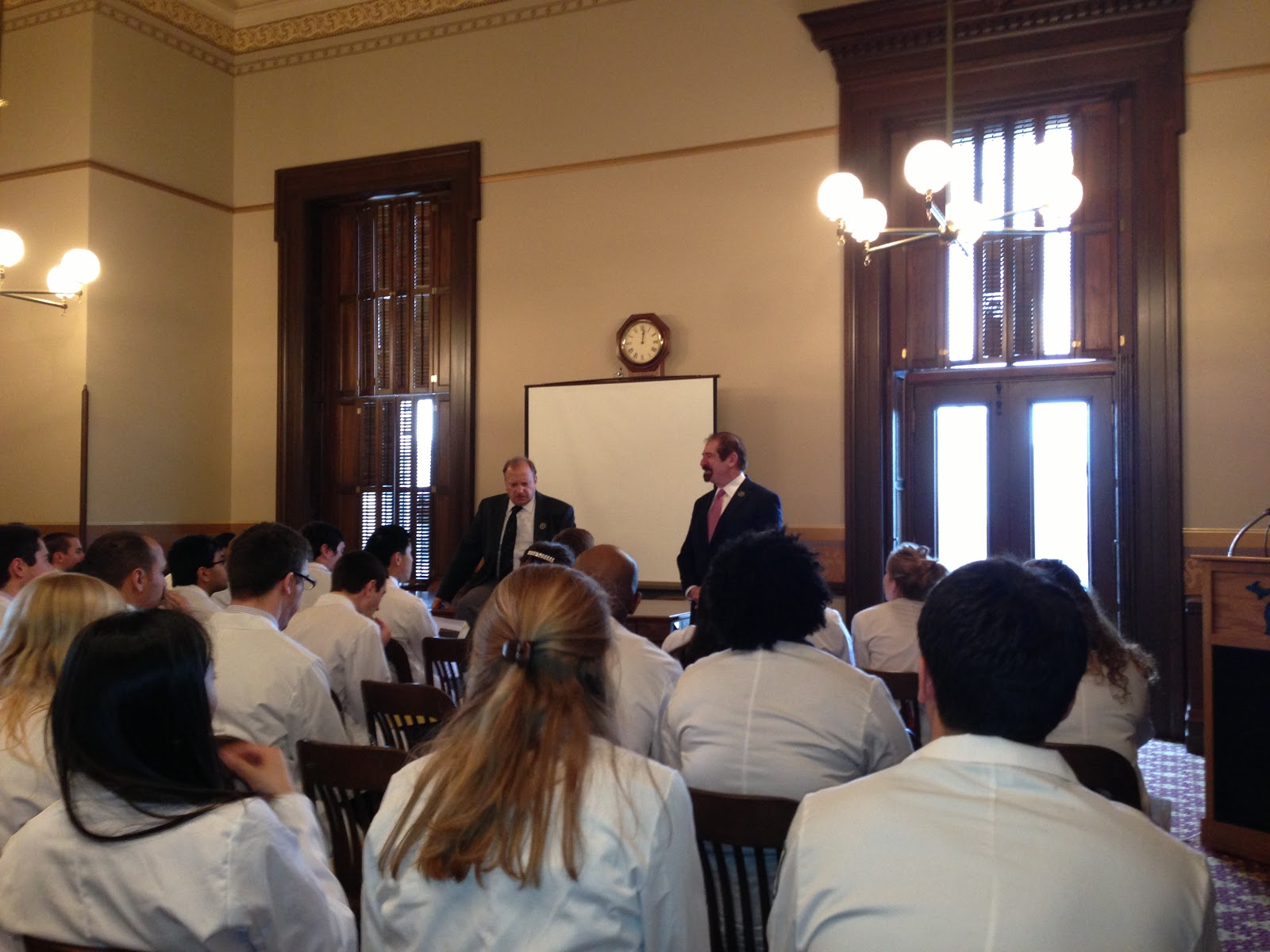 |
| Drs Bizon and Elmassian addressing the Wayne Students. |
Next week should bring more activity in the legislature, stay with MSMS to get the up to date information including when committee meetings are and what they are considering for the day on the House and Senate floors. Go to http://www.msms.org/advocacy to get all of the information you need.
Tuesday, November 20, 2012
Legislative Update: Week of November 19th
With elections finally over and the
legislature facing its final weeks in Lansing, the chaos of lame duck is about
to start. With the House Republicans losing five members, those leaving have
agenda items that they would like to see get done in these short weeks. Those
members find themselves fighting against the Governor who also has issues that
he would like to see completed before the House and Senate head home for the
holidays.
Let’s take a look at what we feel
will be the top five projects the legislature will be working on in this coming
lame duck session:
1.
Blue Cross/Blue Shield
Mutualization: With the Senate pushing through their legislation before Election
Day, we find that the House has a different story. Hearings have started in the
House Insurance committee and have been marathon meetings starting last week
and going through this week discussing issues surrounding Medigap and having
the Attorney General Bill Schutte testifying that with this package we are
pushing Michigan senior towards a cliff, possibly leaving them without the some
of the coverage seniors need. MSMS has amendments it will be looking to
introduce in the coming weeks to the package protecting some the privileges
offered under PA 350.
2.
Personal Property Tax Reform: This
is a request and an issue that is important to the Governor and the Lieutenant
Governor. This has been an interest to this administration in the past. While
LG Calley was a member of the House he was the minority chair for the House Tax
Policy committee where eliminating the PPT was an interest to him at that time.
A good thing for the LG is that Speaker Bolger is of the same opinion as him, I
would imagine that the House will work to get the PPT off the books before they
head home.
3.
Health Care Exchanges: With the
Senate tackling this issue earlier this year, the House had a wait and see
attitude when it came to the exchanges, first waiting for the United States
Supreme Court to render its decision then waiting to see the outcome of the
elections, the House now faces either federal implementation for work hard over
the next few weeks to get a state exchange in place. We'll see what the
legislature can accomplish when the majority feels that this isn't the program
they wanted to deal with.
4.
Regional Transit Authority: With
Detroit dealing with several financial problems, the thought of a regional
transit authority would ease those concerns that surround the transit system.
This issue has come up time after time and has never been able to make it out
of the legislature, maybe this time it could.
5.
PA 4 Replacement: With Michiganders
choosing to take the Emergency Financial Manager act off the books we find the
state going back to the Emergency Manager act taking away some powers that some
would argue were able to get some off the cities and school districts back on
better footing. Now some feel there needs to be a replacement that would still
provide the authority that the managers need to get these municipal units back
on course.
Other items on the horizon could be
mining taxes, educational achievement authorities, and the discussion that with
the failure of proposition 2 and 4 if that is a signal to the legislature that
Michigan is ready to be a Right to Work state.
MSMS will be making our final push
for this legislative session on Tort Reform. We still continue to feel positive
that we could get some movement on this during lame duck. We also will be
working on getting our impaired drivers legislation moved from the House floor
and to the Governor's desk and hopefully seeing movement on Expedited Partner
Therapy by sine die.
Stay with MSMS throughout this lame duck session to get the
latest information affecting you at http://www.msms.org/advocacy.
Friday, June 29, 2012
Legislative Update: Week of June 25th (Special Edition)
Back in late March the Supreme Court of
the United States took up the four suits surrounding the Patient Protection and
Affordable Care Act. The four major questions that were considered by the court
over the three days were:
Today the court renders its decisions on these questions, let's review the opinion:
The court today issued its opinion combining all of the cases together and rendered its opinion in National Federation of Independent Business v. Sebelius, Chief Justice John Roberts issued the opinion of the court which affirmed some parts of the act and reversed other parts of the act. Lets break down the issues:
Anti-Injunction Act:
Arguments against the mandate claimed that the commerce clause of the Constitution did not give Congress the authority to compel the purchase of goods and services and that the ACA compelled the people to purchase health insurance. The government disagreed with this argument and also argued that Congress also had the authority to mandate the purchase of health insurance since the penalty is a tax to those who do not purchase and Congress has the authority to levy taxes under the Constitution.
The majority of the court agreed that the commerce clause of the Constitution did not have the authority to compel the people to purchase a product but the court did uphold the mandate agreeing with the government's second argument that the penalty was a tax and Congress has the authority to levy taxes and that the government is taxing the people either through the purchase of insurance or those choosing the pay the penalty for not purchasing. Chief Justice Roberts writes,
Since the Court ruled that this was indeed a tax the arguments for the AIA issue above by those against the ACA fall.
Severability:
This was a non issue due to the mandate being upheld.
Medicaid:
This section is where those who were against the government actually won their arguments with the Justices. Those against the ACA stated that the Government did not have the ability to "bully" States into the Medicaid expansion by stating their entire funding would be taken away providing the opportunity to be coerced into expanding their Medicaid programs. The Government argued that this was a Government program and Congress had the ability to create any condition and terms for the program it saw fit. The Court disagreed with that opinion. The Court opined that the Government could not keep existing Medicaid funding away from the States that choose not the expand their Medicaid program.
Chief Justice Roberts stated, "The threatened loss of over 10 percent of a State's overall budget is economic dragooning that leaved the States with no real option but to acquiesce in the Medicaid expansion." This now leaves the option to the States whether they choose to expand their Medicaid coverage to the population requirements set in the ACA.
At the end the decision was 5-4 with Chief Justice Roberts and Justices Ginsberg, Breyer, Sotomayor and Kagen concurring and Justices Scalia, Kennedy, Alito and Thomas dissenting.
Chief Justice Roberts finished his opinion with this:
For the entire opinion from the court click here.
1. Is the penalty fee for not complying with
insurance mandate considered a tax and if it is not if the Anti-Injunction Act,
which does not allow persons to sue the government over taxes, to have
jurisdiction over this penalty?
2. Is the mandate to purchase health
insurance unconstitutional?
3. If the mandate is determined
unconstitutional does the rest of the bill still have standing (severability)?
4. Does the expansion of Medicaid coerce the
States to participate in the expansion?
Today the court renders its decisions on these questions, let's review the opinion:
 |
| Chief Justice John Roberts delivering the Court's opinion (courtsey of AP) |
Anti-Injunction Act:
The question that was raised whether the penalty imposed for
not buying insurance is protected under the Anti-Injunction Act (AIA). The AIA
provides protections to the government limiting the ability of someone to sue
the government over taxes. The taxes need to be in effect before a suit may be
filed for harm by the tax. Arguments were that since this was a penalty and not
a tax the people had the ability to sue before the penalty took effect to stop
the future harm it could have caused. Chief Justice Roberts along with Justices
Ginsberg, Kagen, Sotomayor and Breyer disagreed with that argument says that
the government claims for protection under the AIA was upheld due to the next issue.
Individual Mandate:Arguments against the mandate claimed that the commerce clause of the Constitution did not give Congress the authority to compel the purchase of goods and services and that the ACA compelled the people to purchase health insurance. The government disagreed with this argument and also argued that Congress also had the authority to mandate the purchase of health insurance since the penalty is a tax to those who do not purchase and Congress has the authority to levy taxes under the Constitution.
The majority of the court agreed that the commerce clause of the Constitution did not have the authority to compel the people to purchase a product but the court did uphold the mandate agreeing with the government's second argument that the penalty was a tax and Congress has the authority to levy taxes and that the government is taxing the people either through the purchase of insurance or those choosing the pay the penalty for not purchasing. Chief Justice Roberts writes,
"The Federal Government does not have the power to order people to buy health insurance. Section 5000A would therefore be unconstitutional if read as a command. The Federal Government does have the power to impose a tax on those without health insurance. Section 5000A is therefore constitutional, because it can reasonably be read as a tax."
Since the Court ruled that this was indeed a tax the arguments for the AIA issue above by those against the ACA fall.
Severability:
This was a non issue due to the mandate being upheld.
Medicaid:
This section is where those who were against the government actually won their arguments with the Justices. Those against the ACA stated that the Government did not have the ability to "bully" States into the Medicaid expansion by stating their entire funding would be taken away providing the opportunity to be coerced into expanding their Medicaid programs. The Government argued that this was a Government program and Congress had the ability to create any condition and terms for the program it saw fit. The Court disagreed with that opinion. The Court opined that the Government could not keep existing Medicaid funding away from the States that choose not the expand their Medicaid program.
Chief Justice Roberts stated, "The threatened loss of over 10 percent of a State's overall budget is economic dragooning that leaved the States with no real option but to acquiesce in the Medicaid expansion." This now leaves the option to the States whether they choose to expand their Medicaid coverage to the population requirements set in the ACA.
At the end the decision was 5-4 with Chief Justice Roberts and Justices Ginsberg, Breyer, Sotomayor and Kagen concurring and Justices Scalia, Kennedy, Alito and Thomas dissenting.
Chief Justice Roberts finished his opinion with this:
"The Framers created a Federal Government of limited powers, and assigned to this Court the duty of enforcing those limits. The Court does so today. But the Court does not express any opinion on the wisdom of the Affordable Care Act. Under the Constitution, that is the judgment is reserved to the people."
For the entire opinion from the court click here.
Friday, May 18, 2012
Legislative Update: Week of May 14th
This week the legislature took aim at teachers, with the big issue being requiring teachers to give a certain amount of their paycheck towards their pensions, starting 401ks for new teachers entering the system, and changing some of the benefits current retirees have. This doesn't mean that health care took a back seat this week, let's review the weeks happenings:
House:
The House Health Policy committee met this week and considered a series of bills with the largest being House Bill 5643 which would require generic opioids be tamper resistant to prevent the breaking down of the medication for the purposes of a faster delivery. They also voted on House Bills 5089 and 5090 which deals with prescription drug disposal. The committee is expected to vote on House Bill 5643 next week. In the coming weeks the committee is also expected to start their work on Michigan's Insurance exchange that is mandated in the Affordable Care Act.
Senate:
The Senate Health Policy came back from its over month long hiatus to consider Senate Bill 1122 which would set up educational and procedural requirements for high school athletics for the instances of concussion. MSMS has been working with other concerned about the issues of concussion in high school athletics and provided input on the bill that was considered yesterday. The committee took testimony from MHSAA, physicians, parents, and athletes, all praising the efforts of the sponsors to put procedures in place to put the health of athletes first. The bill will be taken up for a vote at the next committee meeting.
Budget:
The story of the week that wasn't surrounding the elections, was the consensus revenue estimating conference that happened last Wednesday. The House and Senate Fiscal Agencies along with the Michigan Department of Treasury sat down and revised their estimates on the amount of revenue coming into Michigan for the coming fiscal year. The conference was nothing but good news for Michigan's future as they forecasted Michigan's unemployment should fall below 8% by calendar year 2014 and the amount of personal income is forecasted to rise, which means more people going to work and putting more money in their pockets.
With this, it also means a bump for the state coffers with a $49 Million increase in revenue for the next coming fiscal year in General Fund/General Purpose dollars. School aide is forcasted to get an even bigger bump of just over $114 Million. This is great news for Michigan showing that the state is in a solid recovery. With the additional $49 Million, GME could see some of that funding head its way, which would go a long way in trying to solve our physician shortage problem. MSMS will continue to monitor and advocate for some of those additional dollars.
The legislature has set their final date before heading home for summer break, June 14th will be the last session day until the fall. For more information on all of the state and federal legislative activities go to http://www.msms.org/advocacy. With the elections coming up we need to support those that support Michigan's physicians. Go to http://www.mdpac.org to find out how you can help!
House:
The House Health Policy committee met this week and considered a series of bills with the largest being House Bill 5643 which would require generic opioids be tamper resistant to prevent the breaking down of the medication for the purposes of a faster delivery. They also voted on House Bills 5089 and 5090 which deals with prescription drug disposal. The committee is expected to vote on House Bill 5643 next week. In the coming weeks the committee is also expected to start their work on Michigan's Insurance exchange that is mandated in the Affordable Care Act.
Senate:
The Senate Health Policy came back from its over month long hiatus to consider Senate Bill 1122 which would set up educational and procedural requirements for high school athletics for the instances of concussion. MSMS has been working with other concerned about the issues of concussion in high school athletics and provided input on the bill that was considered yesterday. The committee took testimony from MHSAA, physicians, parents, and athletes, all praising the efforts of the sponsors to put procedures in place to put the health of athletes first. The bill will be taken up for a vote at the next committee meeting.
Budget:
The story of the week that wasn't surrounding the elections, was the consensus revenue estimating conference that happened last Wednesday. The House and Senate Fiscal Agencies along with the Michigan Department of Treasury sat down and revised their estimates on the amount of revenue coming into Michigan for the coming fiscal year. The conference was nothing but good news for Michigan's future as they forecasted Michigan's unemployment should fall below 8% by calendar year 2014 and the amount of personal income is forecasted to rise, which means more people going to work and putting more money in their pockets.
With this, it also means a bump for the state coffers with a $49 Million increase in revenue for the next coming fiscal year in General Fund/General Purpose dollars. School aide is forcasted to get an even bigger bump of just over $114 Million. This is great news for Michigan showing that the state is in a solid recovery. With the additional $49 Million, GME could see some of that funding head its way, which would go a long way in trying to solve our physician shortage problem. MSMS will continue to monitor and advocate for some of those additional dollars.
The legislature has set their final date before heading home for summer break, June 14th will be the last session day until the fall. For more information on all of the state and federal legislative activities go to http://www.msms.org/advocacy. With the elections coming up we need to support those that support Michigan's physicians. Go to http://www.mdpac.org to find out how you can help!
Wednesday, January 25, 2012
Legislative Update: Week of January 23rd
The legislature is back in session starting out what will be a feverish six months of work. The legislative schedule has the lawmakers in session until July 4th, provided the spring break that is in the middle of the schedule block. Issues facing the lawmakers in the coming months are the budget, changes to Michigan's auto no-fault insurance system, health insurance exchange, and others. Lets review the happenings over the past couple weeks:
Revenue Estimating Conference:
Every January and May the House and Senate Fiscal Agencies along with the Michigan Department of Treasury come together to forecast the revenue for the state in the coming year. Michigan has been showing positive but slow growth since the bottom in 2009. Jobs are on the increase with the all three sectors of jobs, high paying, medium paying, and low paying jobs all growing over the past year and also growing faster than the national average. Housing sales and start ups still continue to be sluggish and are forecasted to continue to stay that way in the coming year. Overall though Michigan is finally on its way out of its long recession with revenues starting to pick up and unemployment slowly moving down. General Fund / General Purpose revenues are forecasted to be up 2.5% from last May's projection placing it at just over $9 Billion. School Aide funding though is projecting for a decline losing 4.3% from this current fiscal year but projections are up from the May conference.
State of the State Address:
The Governor in his State of the State address pointed to his dashboard noticing that Michigan is getting more overweight than we were in the previous year. In trying to combat that trend the Governor is creating a program called Pure Michigan Fit which provides nutrition training to parents and caregivers of children at an early age. The Governor plans to partner with the Michigan Department of Agriculture and Rural Development, The Michigan Health and Hospital Association, and the Michigan Grocers Association to provide the education and resources on nutrition to both parents and children.
House:
The House Health Policy committee had it's last hearing on the health insurance exchanges last Thursday providing the opportunity for those in the general public to address the committee and submit their thoughts about the implementation of a health insurance exchange. The committee was in the House Appropriations chambers, which holds more people, to allow for the number of individuals that wished to testify on the issue.
Senate:
The Senate Health Policy committee did not meet but they did consider one issue. House Bill 4893 on the Senate Floor. This bill provides optometrists the ability to receive a special volunteer license, similar for physicians, and to provide the liability protections offered under the statue. The Senate Health Policy committee has not scheduled a date for an upcoming hearing.
Revenue Estimating Conference:
Every January and May the House and Senate Fiscal Agencies along with the Michigan Department of Treasury come together to forecast the revenue for the state in the coming year. Michigan has been showing positive but slow growth since the bottom in 2009. Jobs are on the increase with the all three sectors of jobs, high paying, medium paying, and low paying jobs all growing over the past year and also growing faster than the national average. Housing sales and start ups still continue to be sluggish and are forecasted to continue to stay that way in the coming year. Overall though Michigan is finally on its way out of its long recession with revenues starting to pick up and unemployment slowly moving down. General Fund / General Purpose revenues are forecasted to be up 2.5% from last May's projection placing it at just over $9 Billion. School Aide funding though is projecting for a decline losing 4.3% from this current fiscal year but projections are up from the May conference.
State of the State Address:
The Governor in his State of the State address pointed to his dashboard noticing that Michigan is getting more overweight than we were in the previous year. In trying to combat that trend the Governor is creating a program called Pure Michigan Fit which provides nutrition training to parents and caregivers of children at an early age. The Governor plans to partner with the Michigan Department of Agriculture and Rural Development, The Michigan Health and Hospital Association, and the Michigan Grocers Association to provide the education and resources on nutrition to both parents and children.
House:
The House Health Policy committee had it's last hearing on the health insurance exchanges last Thursday providing the opportunity for those in the general public to address the committee and submit their thoughts about the implementation of a health insurance exchange. The committee was in the House Appropriations chambers, which holds more people, to allow for the number of individuals that wished to testify on the issue.
Senate:
The Senate Health Policy committee did not meet but they did consider one issue. House Bill 4893 on the Senate Floor. This bill provides optometrists the ability to receive a special volunteer license, similar for physicians, and to provide the liability protections offered under the statue. The Senate Health Policy committee has not scheduled a date for an upcoming hearing.
Monday, December 12, 2011
Legislative Update: Week of December 5th.
This week did not have much activity concerning health issues in the legislature. One issue that MSMS has been tracking was signed by the Governor last week Tuesday. The Matt's Safe School Law was signed into law by Governor Snyder in a signing event that took place at the Capitol in Lansing. This legislation requires schools to have programs to deal with bullying and provide punishment for those who are have broken the policy set by the school. The law took effect with the signature of the Governor. Lets review other happenings in the legislature:
House:
The House Health Policy committee continues to take testimony surrounding the health care exchanges by welcoming Delta Dental to testify. The House continues to work to find ways to pass the auto no-fault changes out but still can not find a consensus on what the changes need to be. With the work they are putting in on the bill and the little sign of movement on the bill it now looks like this could be an issues they will move after the first of the year.
Senate:
The Senate did have some action associated with health care by passing the advanced directives registry out of the Senate. Senate bill 723 provides for the creation of a registry to hold advanced directives for end of life or as the state calls it, "Peace of Mind". You would be able to mail in or enter online your directives for end of life care along with decisions with you estate and others. This is purely voluntary and the information you choose to put in it is whatever you choose.
The Senate Health Policy committee considered several bills including three that would require an insurance rider be add to a health insurance policy to have coverage for an abortion. MSMS does not have an official position on abortion but attended the testimony to support our colleagues from the American Congress of Obstetricians and Gynecologists.
House:
The House Health Policy committee continues to take testimony surrounding the health care exchanges by welcoming Delta Dental to testify. The House continues to work to find ways to pass the auto no-fault changes out but still can not find a consensus on what the changes need to be. With the work they are putting in on the bill and the little sign of movement on the bill it now looks like this could be an issues they will move after the first of the year.
Senate:
The Senate did have some action associated with health care by passing the advanced directives registry out of the Senate. Senate bill 723 provides for the creation of a registry to hold advanced directives for end of life or as the state calls it, "Peace of Mind". You would be able to mail in or enter online your directives for end of life care along with decisions with you estate and others. This is purely voluntary and the information you choose to put in it is whatever you choose.
The Senate Health Policy committee considered several bills including three that would require an insurance rider be add to a health insurance policy to have coverage for an abortion. MSMS does not have an official position on abortion but attended the testimony to support our colleagues from the American Congress of Obstetricians and Gynecologists.
Friday, November 11, 2011
Legislative Update Week of November 7, 2011
With this the final week leading up to the legislature taking a two week break for the upcoming holiday, a flurry of activity was scheduled for each chamber. This as the House loses one of its own, now leaving two vacant seats in the House. Rumors of movement with the Auto No-Fault legislation moving this week seemed to have died down later on in the week leaving the House members to continue to work on the issue.
Not many items moved this week within the chambers that would directly affect the physician community but there were two:
Senate:
The Senate moved House Bill 5014 which is a Appropriations supplemental bill that would provide funding for electronic medical records, this bill was substituted in the Senate to add more appropriations other other departments and was sent back to the House to concur in the amendments. The Senate also moved Senate Bill 693 which creates the framework for the Michigan Health Marketplace (health insurance exchange). With the affordable care act, this had to be created for the State to continue to control its health insurance market and if they do not have something in place by the deadline (end of 2013) the federal government will take over the selling of health insurance. The reason of why the legislature is choosing to act now is that there are federal grants that are attached to programs that are created and approved early which could ease the financial burden on the State.
House:
The House continues do to its work with the Auto No-Fault reform. Expected activity this week did not come to a head so work continues on their reforms.
Election Day Review:
Not many items moved this week within the chambers that would directly affect the physician community but there were two:
Senate:
The Senate moved House Bill 5014 which is a Appropriations supplemental bill that would provide funding for electronic medical records, this bill was substituted in the Senate to add more appropriations other other departments and was sent back to the House to concur in the amendments. The Senate also moved Senate Bill 693 which creates the framework for the Michigan Health Marketplace (health insurance exchange). With the affordable care act, this had to be created for the State to continue to control its health insurance market and if they do not have something in place by the deadline (end of 2013) the federal government will take over the selling of health insurance. The reason of why the legislature is choosing to act now is that there are federal grants that are attached to programs that are created and approved early which could ease the financial burden on the State.
House:
The House continues do to its work with the Auto No-Fault reform. Expected activity this week did not come to a head so work continues on their reforms.
Election Day Review:
Tuesday people all around Michigan went to the polls, voting on local issues and local leaders. There was one election that would leave some effect on the state located on the east side. The final day of the recall efforts against Rep. Paul Scott finally saw its end.
The efforts out oust Scott were started by the Michigan Education Association for tenure as House Education committee chairman working on a passage that revised the tenure system for teachers in Michigan. The changes were not welcomed by the MEA and sparked the efforts to recall the chairman. Those efforts came to fruition last night when the votes ended up in the MEA's favor and successfully recalled Rep. Scott. Once the votes are certified by the Secretary of State the seat will be officially vacated until a primary and general election are announced by the Governor to finish the term.
The efforts out oust Scott were started by the Michigan Education Association for tenure as House Education committee chairman working on a passage that revised the tenure system for teachers in Michigan. The changes were not welcomed by the MEA and sparked the efforts to recall the chairman. Those efforts came to fruition last night when the votes ended up in the MEA's favor and successfully recalled Rep. Scott. Once the votes are certified by the Secretary of State the seat will be officially vacated until a primary and general election are announced by the Governor to finish the term.
The House and Senate are now in Recess, returning after the Thanksgiving holiday. Look for a report the week they are back.
Monday, November 7, 2011
Legislative Update: Week of Oct. 31
Happy belated Halloween to everyone. Things in Lansing continue to move at a smooth and slow pace concerning health legislation. Auto No-Fault reform continues to be at the forefront along with the repeal of the crash helmet requirements for motorcyclists. Here's a rundown of the activity this week in the legislature:
House:
House Health Policy committee continued to take testimony on the creating of a health insurance exchange in Michigan, testimony has been ongoing for almost a month now. The committee also considered House Bill 5131 that would provide some efficiencies for prescription transfers from hospitals to assisted living and nursing facilities.
The House Appropriations subcommittee for Community Health met to continue hearing testimony on programs related to long term care, Michigan MI Choice program and dual eligibles in efforts of understanding the process and looking for possible savings down the road in Medicaid.
The full House considered three items on the radar of the society, HB 5002 that amends the workers compensation provisions, SB 291 that appeals the motorcycle crash helmet requirements and SB 235 that changed provisions associated with criminal sexual conduct and physicians and their patients. All of the bills will be sent to the Senate for their consideration.
Senate:
Senate Health Policy met to consider two bills where they continued their testimony on SB 698 that would create the framework for Michigan's Health Insurance Exchange or known as MI Health Marketplace. They also considered HB 4893 that would provide a volunteer license for optometrists and would provide certain liability protections for volunteers. Physicians currently have this privilege, this would just extend it to optometrists.
The full Senate considered HB's 4411 and 4412 that within the same scope of SB 235 changed provisions associated with CSC, physicians, and patients. Also they considered SB 466 that would create a senior tracking system similar to an amber alert system for children. The Senate also considered and passed out SB 137 that would require school districts to create guidelines for bullying in the school system.
Bill information can be found at http://www.msms.org/advocacy
House:
House Health Policy committee continued to take testimony on the creating of a health insurance exchange in Michigan, testimony has been ongoing for almost a month now. The committee also considered House Bill 5131 that would provide some efficiencies for prescription transfers from hospitals to assisted living and nursing facilities.
The House Appropriations subcommittee for Community Health met to continue hearing testimony on programs related to long term care, Michigan MI Choice program and dual eligibles in efforts of understanding the process and looking for possible savings down the road in Medicaid.
The full House considered three items on the radar of the society, HB 5002 that amends the workers compensation provisions, SB 291 that appeals the motorcycle crash helmet requirements and SB 235 that changed provisions associated with criminal sexual conduct and physicians and their patients. All of the bills will be sent to the Senate for their consideration.
Senate:
Senate Health Policy met to consider two bills where they continued their testimony on SB 698 that would create the framework for Michigan's Health Insurance Exchange or known as MI Health Marketplace. They also considered HB 4893 that would provide a volunteer license for optometrists and would provide certain liability protections for volunteers. Physicians currently have this privilege, this would just extend it to optometrists.
The full Senate considered HB's 4411 and 4412 that within the same scope of SB 235 changed provisions associated with CSC, physicians, and patients. Also they considered SB 466 that would create a senior tracking system similar to an amber alert system for children. The Senate also considered and passed out SB 137 that would require school districts to create guidelines for bullying in the school system.
Bill information can be found at http://www.msms.org/advocacy
Subscribe to:
Posts (Atom)