Thursday, February 13, 2014

Legislative Update Week of February 10, 2014

Budget is the word on the street with both chambers a buzz about the upcoming budget season in Lansing. The official start of the season was on February 6th, when Governor Snyder presented his recommendations for that state budget for the coming fiscal year. This past week state departments started to get down to the individuals budgets for the departments and meeting with their respective appropriations subcommittees. Director Jim Haveman of the Department of Community Health delivered the budget message for to the House and Senate this week. Let's review those messages:

Governor's Budget Message:


Slide from Governor Snyder's Budget Presentation.
Both House and Senate Appropriations members gathered in the House Appropriations committee chambers to hear what message the Governor was going to bring to the legislature on the coming fiscal year. The Governor spent the start of his message reviewing the past three years that the Governor has had the reigns in Michigan. His message of Michigan being the come back state seemed to become the tag line that every member of the committee left with.

In the health arena the Governor wanted to focus new money on the following:
  • An investment of $71.7 million for the Healthy Michigan Plan to implement expanded Medicaid coverage.
  • $15.7 million in gross funding to expand the Healthy Kids Dental program into Kalamazoo and Macomb counties, providing an additional 100,000 children with good dental care.
  • A total of $15.6 million to support the initiatives as recommended in the Mental Health Commission final report that was issued Jan. 2.
The Governors Mental Health Commission had recently reviewed their findings from their hard work to a joint meeting of the House and Senate Health Policy committees a few weeks ago but from that meeting there was no talk of what the Governor wanted in terms of funding for program, with the presentation of the budget lawmakers found out how much some of the efforts of the commission was going to cost. 

The Healthy Michigan Plan along with Healthy Kids Dental both saw bumps in funding as well, as the Governor continues his push to expand coverage for health care and dental care for children in Michigan. Moving away from health the Governor also talked about road funding and a need for an increase in funding and toted a funding increase for schools that is directed to the classroom. You can see the governor's presentation here

Director Haveman's Presentation:

Director Haveman had the daunting task of breaking down the budget for his department, providing both the House and Senate a presentation of the accomplishments of the current fiscal year and what the road map for the coming fiscal year looked like for the department. The Governor in his state of the state address said that he wanted to make Michigan a "no wait" state for certain services. The Department of Community Health Houses some of those services, lets review the recommendations for the coming year:
Slide from Director Haveman's Presentation.
  • Overall Budget: $17.4 Billion Gross / $2.9 Billion General Fund (GF)
  • Mental Health and Wellness Commission - $15.6 Million Gross
  • Jail Diversion Initiatives - $3.4 Million (DCH Investment)
  • Child and Adolescent Health Services Pilot - $2 Million Gross/GF
  • Home visitation in rural areas - $2.5 Million Gross/GF
  • Crime Victim Grants - $1 Million Gross (From Crime Victim Fees)
  • Make Michigan a “no wait state” for senior home delivered meals and in home services - $5 Million Gross/GF
  • Increase Program of All-Inclusive Care for the Elderly (PACE) site options - $16.4 Million Gross / $5.7 Million GF 
  • Make Michigan a “no wait state” for the MiChoice Home and Community Based Waiver Program - $26.4 Million Gross / $9 Million GF
  • Prevent Elder Abuse - $1 Million Gross/GF
  • 2013 and 2014 Primary care rate increases to physicians - $75.5 Million  gross / $26 Million GF investment continues one half of the rate increase 
  • Healthy Kids Dental expansion - $15.7 Million Gross / $5.4 Million GF
You can see the full presentation delivered by the director here. Graduate Medical Education was a topic that briefly touched upon in the committee. It is expected that further discussion on the administrations direction with the budget will come when the Medical Services or Medicaid will report to the committee in the coming weeks. 

The budget hearing will continue through  February and March. Stay with MSMS to get the latest up to date news on the budget process and more as issues break at http://www.msms.org/advocacy . 

Tuesday, January 21, 2014

Legislative Update Week of January 20, 2014

With an overhaul and update of the blogging site, the MSMS Legislative Update is back up and running again and we are happy to provide the latest up to date happenings in Lansing and beyond. This month we find the legislature facing it's final year of the term, leaving law making playing second fiddle to the upcoming campaigns ahead of the lawmakers. This also means the timetables are accelerated which leaves the possibility of a state budget being done before the start of June. Lets review the happenings of the legislature over the past couple weeks.

Consensus Revenue Estimating Conference:

The month started out, as per usual, with the two fiscal agencies and the Michigan Department of Treasury coming together to sign an agreement on the amount of tax dollars the state will have to spend in the coming fiscal year and how the economy in Michigan is looking and will look in the future. All parties agreed that Michigan is continuing its financial recovery at a slow up strong pace. Current new starts of homes are continuing to rise in Michigan and are projected to continue on that upswing. Good news for those working and those looking for jobs with the personal wealth of people continues to rise and unemployment is projected to fall leaving people with work and more money in their pockets.

As for the state's coffers those continue to rise as well. Tax reforms done by the legislature with the cutting of the Earned Income Tax Credit, modifying the homestead tax credit, and the elimination of the child deduction, Michigan will decrease it's tax expenditures by $2.5 Billion for FY 13-14 (courtesy of the Senate Fiscal Agency). This for the coming fiscal year law makers found out that they will have an additional $474 Million to appropriate. Some are calling for a tax refund, some would like to see road work, some would like to see the tax deductions put back into place, but it will be a wait and see until the Governor releases his budget recommendation to see where the money ends up going. Click on the link to see the final estimates.

State of the State Address:

Governor Snyder delivering fourth State of the State Address.
Courtesy of MLIVE.
On January 16th Governor Rick Snyder presented his report to the legislature on the report card of Michigan. The speech started out with a review the past three years of the Governor's term talking about the points that he was proud of accomplishing including the safe sleep initiative, a policy move that MSMS supports. From there Governor Snyder moved towards his agenda on what he wanted to do yet and really started laying out his campaign platform for the coming elections. Here is a great breakdown from our multi-client lobbyists at Capitol Strategies Group:

The Governor presented his annual State of the State address Thursday evening in Lansing in front of a packed House chambers on a snowy night in Lansing. Many of the pundits in Lansing concluded the speech lacked many specifics, but below is excerpts from the speech released by the Governor’s press office.

  • Snyder will create the Michigan Office for New Americans, which will drive strategies for attracting immigrants to Michigan. Snyder also is urging Congress to approve Michigan’s application to become only the second state with a state sponsored EB-5 visa regional center. The EB-5 is a tool for attracting investment and creating jobs for U.S. workers.
  • Stepping up efforts to connect job providers and talent. The governor this year again will host economic and education summits to foster greater collaboration between the private sector and education community.
  • Expanding the Michigan Advanced Technician Training (MAT2) program, an employer-driven initiative that helps employers bridge the “skills gap” through a statewide system for training and educating skilled technicians to fill high-paying jobs. Henry Ford Community College and Oakland Community College will serve as pilot locations for the program, which is a unique model that also includes best practices from Germany.
  • Continuing the successful Community Ventures program, a public/private/nonprofit partnership created to hire at least 1,000 structurally unemployed residents from distressed neighborhoods, initially in the cities of Flint, Detroit, Pontiac and Saginaw. First-year goals have been met, resulting in jobs for over 1,400 structurally unemployed residents.
  • Supporting small businesses through creative partnerships. Under the Pure Michigan Micro Lending Initiative, Huntington Bank has committed $5 million for a pilot program in Detroit to help small businesses grow. Upon its successful completion, Huntington will commit $20 million more to be distributed through lines of credit to community micro lenders. Under another initiative, the 10,000 Small Businesses program, Goldman Sachs announced a $20 million partnership to help entrepreneurs in Detroit by providing access to education, financial and business support services.

21st Century Education

Ensuring that Michigan’s education system is indeed a 21st century system that reflects the needs of this technology age. This includes:

  • Encouraging schools to consider a voluntary program in which they would extend classes year-round, rather than interrupting student learning with a three-month summer break. It can take weeks for many children to recover the information they learned prior to leaving for the traditional summer vacation, which delays the learning of new material. Under this concept, students still would get shorter breaks throughout the summer. Snyder applauded the Legislature’s bipartisan effort to explore this concept and urged further action.
  • Providing a uniform definition of “truancy” to schools across the state. Doing so will result in greater consistency and will provide educators, human service providers, judges and police with ample opportunities to customize assistance to families so that the number of truants can be reduced.
  • Implementing recommendations of the Michigan Council for Educator Effectiveness. The council recommended a fair and rigorous means to evaluate the skills of teachers using a combination of observed classroom practice and measured student growth.
  • Making Michigan a leader in promoting STEM programs in schools and colleges. Jobs are robust in the fields of science, technology, engineering and math. Michigan must do a better job of aligning education with economic trends and inevitability.

Quality of Life

Improving the quality of life in our communities, as well as for seniors, and residents with special needs. The governor said:

  • Michigan should become a “no wait state” for seniors who qualify for home delivered meals and in-home services. Nearly 4,500 seniors are not receiving the in-home services including home-delivered meals that they need. In Southeastern Michigan, half of the people qualifying for services must wait six months or more to receive services. The governor will propose additional funding in his recommended budget to eliminate this waiting list. The governor also announced that he will prepare a special message outlining opportunities to reinvent the way in which Michigan provides services to seniors.
  • Lawmakers should pass pending bills that provide consumer protections for seniors.
  • Adopting recommendations of the Mental Health and Wellness Report will help people with mental illness, substance abuse disorders or developmental disabilities to lead more independent lives. Recommendations include developing a Pure Michigan marketing strategy to highlight opportunities for families living with disabilities, and having Michigan join the “Spread the Word to End the Word” movement, which seeks to rid our vocabulary of derogatory terms regarding people dealing with mental illness.
  • Michigan should enact laws that provide school safety drill recommendations, and encourage schools to report on completion of the drills to the state. Snyder will propose funding in the upcoming budget for school safety initiatives.
  • The quality of life for nearly half-a-million Michiganders will be enhanced now that the federal government has approved the Healthy Michigan Plan. By improving access to affordable health care coverage, Healthy Michigan also will reduce uncompensated care that shifts costs onto businesses and taxpayers.
  • Significant progress is being made in reducing the crime rates in Pontiac, Detroit, Saginaw and Flint. While the rates remain unacceptably high, it’s clear that the state and local partnership under the Secure Cities Initiative is having an impact. In the first 10 months of 2013, violent crimes declined by 30 percent in Flint; 16 percent in Saginaw; 7 percent in Detroit and 6.5 percent in Pontiac.

Protecting Our Environment and Natural Resources

Ensuring the protection of Michigan’s natural resources while allowing for their wise use, the governor called for:

  • Increasing the state’s effort to combat invasive species, which cause environmental damage, as well as economic harm in excess of $4 billion annually across the Great Lakes region. The governor will recommend funding in the new fiscal year to implement a program aimed at preventing the introduction and spread of both aquatic and terrestrial invasive species. The program was developed through a partnership with the DNR, Department of Environmental Quality and Department of Agriculture and Rural Development.
  • Using the information gathered last year through numerous public forums to develop a framework for the comprehensive energy policy that Michigan needs. In December 2013, Snyder used that information to set the stage for critical discussions on Michigan’s energy needs as they relate to adaptability, affordability and reliability.

Good Government

Continuing with the reinvention of state government so that it is customer-focused and delivers the best possible service. The governor proposed that:

  • Michigan should join other states in passing a resolution that supports a Federal Balanced Budget Amendment to the U.S. Constitution. Unlike Michigan, Washington still lacks the fiscal discipline to balance its budget, which hampers the nation’s economic turnaround. Passing this amendment sends a strong signal to Washington that fiscal responsibility is needed for the good of working families and all taxpayers, as well as future generations of Americans.
  • The state enhance its “early warning system” to assist communities and schools facing financial instability. Creating strong financial intervention teams, housed within the departments of Treasury and Education, will allow for earlier intervention strategies. This is in the best interests of children and taxpayers.
  • While continuing to be fiscally responsible in the short and long term, it is appropriate to provide some tax relief to hard-working families. Michigan has come a long way in three years. The state’s fiscal health has improved due to the tough but necessary decisions that have been made. The governor will make an FY 15 budget recommendation that eases the burden on low- and middle-income families so that they can continue to share in Michigan’s comeback.


The state now looks ahead with the Governor's budget message on the horizon to start working to get the budget done before their self imposed deadline of June 1.

MSMS will continue to follow the activities of the budget and other areas. Find all of that information at http://www.msms.org/advocacy. Your support helps us get the policies you want passed by the legislature. Go to http://www.mdpac.org to see how you can help!

Wednesday, September 4, 2013

Legislative Update Week of August 26th.

With the leaves starting to turn, children starting to collect their supplies for the upcoming school year and the sounds of football filling the weekends, it must mean that fall is around the corner. With that also means that the legislature is back in session ready to deal with the pending question that everyone has been working on and waiting for an answer to, Medicaid Expansion HB 4714. The Senate met this past week on Tuesday to finally answer that question, but lets review how we ended up here.

June:

The House has passed their version of the Medicaid Expansion leaving it to the Senate to work on the issue before the legislative summer break. The Senate discharges the bill from committee consideration the last week of session starting the debates internally in the Senate Republican caucus on how they were for or against the expansion. During this time the Governor is away on an economic mission in Israel and the Lieutenant Governor was in the Upper Peninsula of Michigan leaving the executives out of Lansing and leaving Medicaid floundering.

Wednesday of the final week the Lieutenant Governor cuts his trip short to head back to Lansing to work with the Senators to somehow help push Medicaid over the finish line in the Senate. At the same time two other Senators say they are working on or have alternative proposals for the Senate to consider. After Wednesday no progress had been made in moving the vote forward leaving Thursday the final day before the legislature headed out for summer and leaving the Governor on a plane back from Israel to Michigan to try to push the expansion over the finish line.

The Governor made his appearance just before noon on Thursday and starting meeting with individual senators one on one, trying to get their issues solved so that the Senate could vote on Medicaid that day. Hours dragged on leaving by 5:00 pm that day still votes short in the Senate and a frustrated Governor having a press conference saying that the Senate should stay rather than go home and solve the expansion issue. The Senate had another plan and sent the Medicaid expansion bill to the Senate Government Operations committee where a work group would be created to work on the bill over the summer. The Senate broke for the summer leaving Medicaid still hanging in the wings.

July and August:

Senator Richardville convened the Government Operations committee announcing that there would be a work group that would be drafting legislation that would be suitable to all parties in the Senate and that they would meet on a weekly basis. Senator Kahn, MD was the lead of the work group, using his experience as a physician to provide clarity, insight, and leadership to the work group. The Government Operations committee would meet every two weeks looking for an update on the progress of the work group and report to those who attended the committee meetings.

The workgroup finally came to the committee with a product at the end of July where then the committee took testimony from the interested groups on their opinions and either support or nonsupport for the legislation. The committee also considered two other Medicaid plans that were provided by Senators Collbeck and Caswell. SB 422 and SB 459 and SB 460 were the alternative plans provided to the committee. Many of the groups testifying supported HB 4714 but did not provide their support for the other pieces of legislation. At the end of the committee meeting all three plans made it out where a showdown was expected on the Senate floor.

August 27th:

The Senate came in for their final summer session day with high stakes looming over the Senate. This was the day that the Medicaid vote was going to happen, leaving the hallway to the Senate chambers full of advocates for or against Medicaid expansion ready to push votes the way they wanted to. The Lieutenant Governor was ready to break any tie votes that had come on the floor; the stage was set. The Senate took up HB 4714 where the vote on it the firs time left them one vote short 19-18 with Senator Collbeck abstaining from voting. Since this wasn't a majority of the Senate voting for the bill failed.

A reconsideration motion was made quickly after and the leadership of the Senate along with the Governor's office continued to work on the members that were still in opposition of the legislation. Finally after some amendments the vote was taken again and this time Senator Casperson, a Republican from Escanaba, switched his vote and voted for the expansion allowing the legislation to pass 20-18. The legislation still waits in the Senate thought since the chamber fell two votes short on granting the legislation immediate effect. The Senate will be considering this on Tuesday September 2nd when they come back to start their fall schedule.

Stay with MSMS to get all of the up to date information surround Medicaid other issue at http://www.msms.org/advocacy.

Friday, June 21, 2013

Legislative Update Week of June 17th


The Legislature saw the light at the end of the tunnel with this being the final week before they leave on their summer recess. This week started with the Lieutenant Governor in the Upper Peninsula and the Governor in Israel working on creating economic development for Michigan but with the Medicaid expansions hanging in the balance, we saw trips being cut short with both the Lieutenant Governor and the Governor coming back to Lansing to try to get the Medicaid expansion across the finish line. Let’s review the week:

House:

The House started out this week with having a number of topics on the agenda including House bill 4736 that would allow Expedited Partner Therapy in Michigan. This was on the agenda for Wednesday for the House to take up but everything took a back seat to what was happening across the hall in the Senate.

Senate:

The Senate found itself in the limelight, where it wanted it or not, this week with the possible consideration of HB 4714 or the bill that addresses Medicaid expansion. Starting out the week the Senate Republicans were having troubles meeting their own imposed requirement where a majority of their caucus has to vote in favor of the legislation before they will consider an issue on the full Senate floor. Wednesday found the majority of those lobbying in the Capitol working on the Senate asking Senators to support the expansion. The Lieutenant Governor made his want back to Lansing to join those lobbying the Senate Republicans on supporting the exchange. At the end of the day, Wednesday saw no action on the expansion and left some wondering if it would ever get done.

Thursday and final day of session before the summer break, found those hoping for the Medicaid expansion to make its way to the Governor's desk, but with the Governor gone in Israel for the past week, it was hard for supports of the legislation to find any hope of moving the issue forward. Then word came that the Governor was on his way back to Lansing and would be at the Capitol before noon. With the Governor's arrival eminent, supports continued working with Senators to push them to support House Bill 4714. When the Governor arrived, he talked with his staff that had been working on the Senate, giving him a status report, and then started working members of the Senate. This went on for most of the afternoon where he also called representatives from the supporting groups to fill them in on his progress which was not promising at the time.


Kenneth Elmassian, DO, President of MSMS in the background at
the Governor's Medicaid Expansion Press Conference.
From the Detroit News
http://www.detroitnews.com/article/20130620/POLITICS02/306200084
Finally, after five hours of working the Senate, the Governor called a press conference with supports of the expansion asking the Senate to take a vote on the expansion rather than heading home for summer break. Kenneth Elmassian, DO, President of the Michigan State Medical Society was there for MSMS. "Every discussion about health care and health policy in Lansing should start and end with what is best for Michigan patients. The Healthy Michigan Plan puts patients first, helping more families receive the health care they so desperately need while being responsible with residents' tax dollars," said Elmassian in a statement. He went on to say, "Physicians across Michigan are grateful for Governor Snyder's steadfast leadership and look forward to working with lawmakers this summer and into the fall on reforms that put patients first."

Now the Senate will be back in August on the 27th to hopefully finish the work done on the Medicaid expansion, those supporting the package now have until August to continue working to garner support for the package. The blog will now take a break until the legislature comes back into session in August. Follow MSMS though through our twitter feed and Facebook page to get up to date information on what is happening over the summer at http://www.msms.org/advocacy.

Monday, June 17, 2013

Legislative Update Week of June 10th

With the clock ticking away on the amount of time left in the legislative calendar for this first part of the year, Medicaid reform was front and center throughout the entire week, leaving one chamber looking on to see what would be done. Let's review the past week.

House:

With the Senate looking on the House Michigan Competiveness Committee was signaling that there was a substitute bill to House Bill 4714 at the start of their meeting on Tuesday, where the committee continued to take testimony, this time from those individuals who are associated with the Tea Party. Comments offered to the committee from those testifying had nothing to do with the legislation but rather how they disliked the Affordable Care Act and any expansion of any government service or program. After the testimony from the Tea Party the committee adjourned and reconviened on Wednesday where they approved the legislation as substituted along with some amendments that were also tacked on by members of the committee. A further analysis of the legislation can be see here.

Dr. Kenneth Elmassian, President
of MSMS sharing his feelings
about the Michigan Medicaid Reform.
Wednesday the House moved the legislation through second reading leaving a showdown within the Republican caucus on Thursday to move the legislation out of the House to the Senate. The day started at it's usual time with both caucuses heading back to their respective rooms to discuss the upcoming vote on the Medicaid reform package. The subsititute stripped out some of the harsh language including the 48 month drop out of the program was changed to after 48 momths increasing co-pays for the program. Also an amendment was added that at the end of the 48 months a 90 day period would be added on to allow patients to be ready for the changes. After hours of working the room, those support the legislation were able to get the votes needed to pass the bill to the Senate with a vote of 76 for and 31 against.

Now the legislation heads to the Senate as they choose what to do with it over the summer break. The House did also send legislation to the Senate that would allow those who have military expereince to use that if they are looking to be licensed as an EMT. This was part of a larger package aimed to help veterans coming home looking for a job.

With a week left there are several issues still on the docket that both chambers are looking to complete before the summer break. Stay with MSMS to get the up to date information on the issues that will effect the physician community. Go to http://www.msms.org/advocacy to get all the information.

Friday, June 7, 2013

Legislative Update Week of June 3rd.

With the summer recess looming on the horizon, both chambers are looking to finish up some of the larger issues that have been on the plate for the legislature. Lets review the activity of this week and whats still to come:

Senate:

The Senate concurred with the conference report for the General Government Omnibus budget, which covers the Department of Community Health budget as well. With the budget now agreed to by the both House and Senate, it will be heading to the Governor's desk for his signature.

House:

The House Michigan Competitiveness Committee convened again this week to consider the House Republican Medicaid Reform package. House Bill 4714 would require the state to ask for a waiver for their Medicaid program that would require full support of expansion by the Federal Government along with a 48 month limit for those able bodied individuals using Medicaid. There were rumors that the legislation was going to be voted out this week by the committee but it did not happen. Instead there was notification that a substitute piece of legislation would be introduced which would make the plan more attractive to the groups who are against this major change. We wait to see what the substitute legislation will look like, but signals from the chair of the committee along with the Speaker of the House is that the new legislation will have the 48 month limit included in it.

The House Judiciary committee came together with the House Health Policy committee to take testimony on House Bills 4694, 4695, 4696 and 4697, which is enabling legislation to create Mental Health courts statewide in Michigan, bring them under the authority of the State Court Administrator's Office (SCAO) and allow them to direct funding for the program. The General Government Omnibus budget included $2 Million for the courts in Michigan, now with this legislation it these court could become a reality. The joint committee heard testimony from those involved in the Mental Health court in Kalamazoo on Tuesday when the joint committee meet. The Judiciary committee continued taking testimony on this issue on Thursday  hearing from the judge in charge of the Mental Health court in Kalamazoo. This legislation is likely to be moved out of the committee at their next meeting as this was one of the issues that Republicans were interested in moving before the start of the break.

The House Health Policy Committee also meet this week to consider a host of issues including taking a vote on House Bill 4736, a bill that would bring EPT to Michigan. The legislation made it out of committee with no signs of fight back from the members of the committee with a vote of 13 yes votes 0 No votes and 2 passes. Now the legislation will be sent to the full House for their consideration and we are hopeful for a vote before the House members leave for break. The committee also took a vote on changing the grade requirement for immunizations. The push to to move the record from 6th to 7th grade since those who are in 6th grade may be younger than what traditionally someone in 6th grade would be. This legislation headed to the House as well.

The Coming Weeks:

The House has several large issues they are looking to tackle before heading home on their summer recess. Transportation and road funding is the major problem facing the legislators at the moment. Looking to increase the tax on gasoline while it is so high or tacking on an increase to your registration fees are just a couple of the ways the House is looking at to solve this road funding issue. Medicaid expansion will be in the limelight for the next couple weeks as well. The House is committed to get their Medicaid reform legislation to the Senate before break. Those are the two largest issues facing the legislature that are trying to be teed up to send to the other chamber.

For more information on what is happening in Lansing and beyond follow us at http://www.msms.org/advocacy. You can get all of the information there and from our Facebook and Twitter feeds. What to know what is happening politically? Check out MDPAC at http://www.mdpac.org to get all the information on who will be running for what in the coming months ahead.

Sunday, June 2, 2013

Legislative Update Week of May 27th

This week the legislature saw a short but very important week with the House working hard to meet it's self imposed deadline of getting the budget approved. Let's take a look at what happened before the legislators left for the week:

Budget:

The Detroit Regional Chamber had it's annual policy conference on Mackinac Island this week that included names like Governors Jeb Bush and Scott Walker. This left the legislator looking at a shorten schedule for this past week with the conference starting on Wednesday. The House started with the School Aide budget with an increase in the foundation allowance for most school districts around Michigan that averaged out to $52 per student. The Senate agreed with the House and the Conference Committee' s work and passed the Education Omnibus budget, sending it to the Governor for his signature.

The General Government Omnibus budget is still in limbo. The House received the report of the Conference Committee, a report that came without the Medicaid Expansion. Mental Health Services saw the majority of extra funding with the Governor's push for greater access and increased services for those needing mental services. The House voted the bill out on party lines to the Senate for their approval but the Senate decided with the short timeline for the week that they were not interested in rushing the budget through. The Senate will be considering the budget this coming week.

This coming week the budget will be finalized, Expedited Partner Therapy could see a vote in the House Health Policy committee along with other action. Stay will MSMS to get the most up to date information at http://www.msms.org/advocacy.

Friday, May 24, 2013

Legislative Update week of May 20th

The end of the yearly budget race is now in the sights of the lawmakers as the leadership teams of both houses were able to come to an agreement on where they wanted to budget to fall out, does that include the expansion of Medicaid, let's review the activities of the week.

House:

The House Health Policy committee this week took testimony on a host of legislation. House Bill 4736 which would bring Expedited Partner Therapy to Michigan, that could make it the 36th state to put this policy into place. Dr. Annette Mercatante, health officer of St. Clair County Health Department, testified on behalf of MSMS and the Michigan Association of Local Public Health. Dr. Mercatante was able to provide the experiences of those working in the public health field and those working in the local public health departments. Dr. Jody Jones testified on behalf of ACOG providing the aspects of pregnant mothers and their unborn children. The committee also considered Senate bills 237, 238, and 239 that would change immunization requirements by having children be immunized by the 7th grade rather than the 6th grade. It is expected that the House committee will take the legislation up for a vote on June 4th.


Senate:

The Senate Health Policy committee also met this week considering two items during their meeting. The the State deciding not the implement their own health insurance exchange, regulations have to now be put into place to deal with the impending changes. One of those changes came up in the committee in the form of Senate Bill 324 that would provide some regulations for navigators of the exchange. This bill rushed out of committee and on to the Senate floor where it has been posted to be considered in the House Health Policy committee on June 4th. Senate Bill 373 was also considered which would allow the Board of Pharmacy to allow for pilot projects for applications of prescriptions. This legislation will be heading to the House as well but not at the same speed at the navigators legislation.

Budget:

This week the final hurdle was crossed by the legislator allowing for the considerations of the different departmental budgets. Last week the May Revenue Estimating conference met letting the legislators know that there was just over $400 Million extra revenue coming into the State for the next fiscal year. major questions of road and education funding, a fix for the HICA tax that funnels into Medicaid, along with other ideas were thrown out on the table for consideration. After discussions between the leadership the decision was made to put the majority of that funding into road construction and maintenance and also putting $75 Million into the State's rainy day fund.

This left no discussion of a fix for the HICA tax shortfall and the Medicaid expansion with the news of the spending priorities with the new found money. This goes for the agreement discussions as well between the House and Senate leadership when looking at finalizing the numbers for the coming year's budget, leaving the Medicaid expansion off the table. Signs are not positive for those support the expansion with the feasibility of the expansion being including in this budget bill less likely by the day, leaving the legislator no choice than to do a separate bill if they choose to expand the program.  Conference committees will start meeting next week with the hope that a budget solution will be found by the end of next week.

Stay with MSMS to get the up to date information on what is happening in Lansing and beyond; go to http://www.msms.org/advocacy. Your support keeps physician issues on the forefront of the legislators, we need your continual support, go to http://www.mdpac.org to see how you can help today.

Friday, May 17, 2013

Legislative Update Week of May 13th


The Legislature received it's updated estimates on revenue for the coming fiscal year on Wednesday which sparked activity on the budgets in the House and Senate. The Senate finally sent its MDCH budget proposal to the full House without the Medicaid Expansion dollars realized in the budget, while House Republicans started taking testimony on their solution to the Medicaid question. Let's review the activities of the week:

House:

The House this week in the common procedural move "zeroed" out the budget proposals that the Senate sent to the House and sent them back which now sets up the budgets to go to conference committee. One lingering issue that the House will most certainly address next week is the MDCH budget that was finally sent to the House for their consideration without the Medicaid Expansion dollars allocated in the budget, leaving the question still on the table of the expansion will survive in Michigan.

The House Health Policy committee this week considered Senate Bill 165 and House Bill 4156 in its traditional second hearing fashion was looking to take a vote on the legislation. The committee provided a substitute to Senate Bill 165 and House Bill 4156 and sent them on their way to the House floor for consideration. The Senate bill will have to be sent back to the Senate for concurrence since the House amended the bill.

The main attraction this week was actually the House Michigan Competitiveness Committee which had House Bill 4714 which is the Republican answer to the Medicaid Expansion question. Committee meetings on this legislation started on Tuesday with hearing in the afternoon and then continued again on Thursday. Republicans are looking for major Medicaid reform and on Thursday had the opportunity to ask the Michigan Department of Community Health Director Jim Haveman and Medicaid Director Steve Finton if they felt that direction Republicans were taking was a good idea and to provide a general overview of the current system in Michigan. It is expected that the process will continue into the next week or two before any potential action from the committee.

The Senate

The Senate Health Policy committee reconvened this week where health insurance was on their radar. The committee considered Senate Bill 324 which would provide the licensure and governance of insurance "Navigators" in Michigan. With the pending implementation of the health insurance exchanges the use of navigators will be crucial to those looking to obtain health insurance. Currently under Michigan statute there is no mention of navigators leaving them to be unlicensed and unregulated on a state level. The committee just took testimony on the legislation and would expect to vote the legislation out before the summer break begins.

Expedited Partner Therapy Press Conference

On this past Thursday the National Coalition of STD Directors (NCSD) along with MSMS, the Michigan section of ACOG, MALPH, and the Michigan Pharmacists Association had a press conference and reception to education lawmakers on the policies of Expedited Partner Therapy. Representatives Gail Haines and George Darany were gracious hosts of the reception and press conference with Representative Darany being able to highlight his legislation House Bull 4736 that would bring EPT to Michigan.
     
"The treatment is critical to prevent reinfections and further transmission for untreated partners," Rep. Darany said in the press conference. Jeff Phillips, MD represented MSMS at the press conference providing his thoughts and expertise to the panel. "It's frustrating seeing these patients come back time and again with an infection that is easily treatable," said Phillips after the press conference. Stephanie Arnold Pang from NCSD provided the national outlook of the practice of EPT and what they are seeing from the different states that have implemented the policies. "If you don't treat a partner of a patient with an STD, the treatment of that index patient is not effective, they are just going to be reinfected and it will cause more costs and visits on our health care system," said Arnold Pang. The legislation is now scheduled for a hearing on May 21st with a possible voting out of the committee on June 4th.

Stay with MSMS to get the most up to date information on all of the items MSMS is following in the legislature and beyond at http://www.msms.org/advocacy.

Friday, May 10, 2013

Legislative Update Week of May 6th

This week Medicaid took the spotlight away from all of the other activities as the House Republicans produced their plan to reform Medicaid so that they could accept the expansion of the highly utilized program. Let's review that and the other activities of the week in the Michigan Legislature.

House:

The House saw little activity this week as the Tulip festival was underway on the west side of the state. This left little action by committees and the full House. The House Health Policy committee did schedule a hearing for the 14th where they will be likely voting on the Senate Bill 165 and House Bill 4156.

Senate:

The Senate this week considered Senate Bills 237, 238, and 239 which would change the grade requirements for immunizations in Michigan. The Senate Health Policy committee saw little to no objection of moving this legislation forward and neither did the full Senate Floor. The bills passed the floor without any objection and have now moved to the House where they have been referred to the House Health Policy committee.

Medicaid Reform:

Outline of Republican Medicaid Reform
Source: Michigan Republican Caucus
Over the past several months the Legislature has been grappling with expanding Michigan's Medicaid program to bring in those individuals who are at 133% of poverty or worse in to the program. Many in both chambers feel that they are setting up Michigan for legacy costs that could hamper the other essential services that the state provides, for example road funding and education. MSMS, the Michigan Hospital Association, along with other medical groups have come out with the Governor and supported the expansion.

Feelings in the legislature still where they were when the expansion was first announced found themselves asking for reforms in Medicaid, where it has the perception of being a huge money drain that is full of inefficiencies and waste. From the mindset both House and Senate members have been trying to find a way to reform Medicaid to allow for the expansion to happen while continuing to be fiscal responsible. House Republicans this past Thursday feel that they have the answer.

Their plan (House Bill 4714) looks like this:

  • Requires that the expansion be 100% funding by the federal government.
  • Would require those on Medicaid to pay a co-pay or deductible that falls within 5% of their income.
  • Would set up Health Savings account for those on Medicaid.
  • Preventative care would be a little or no cost to the patient.
  • Providing incentives for those patients on long term care to get well and make themselves better.
  • Options to those on Medicaid to choose private plans for insurance, similar to a insurance exchange except specific to Medicaid.
  • Would only allow those who are single and able to be on Medicaid for 48 months which is seeking to rid them of an entitlement feeling.

It is uncertain when and if this proposal will receive a hearing but be assured it will be similar to the Auto No-Fault or Tort Reform hearings that have happened in the past. Stay with MSMS to get all of the up to date information on this and others at http://www.msms.org/advocacy.


Friday, May 3, 2013

Legislative Update Week of April 29th

Words of Auto No-Fault reform continued to stay in the air this week as the House Insurance committee while the topic of abortion found its way to the Senate Judiciary committee. Let's review the events of the past week:

House:

The House Health Policy committee met this week and considered two items which the committee took only testimony. The first bill was House Bill 4156 which would create liability protections for nurses who are practicing under a special volunteer license. This practice is common for other health professionals including physicians, dentists, and others. Little opposition was brought to the committee's attention and this bill should be voted on next week in the committee. The second bill the committee reviewed was Senate Bill 165 which would require hospitals to provide in writing information to the patient's parent or guardian, if the patient was a minor, on the use or non use of life sustaining treatment or non beneficial treatment. The committee is expected to vote this legislation out in the coming week as well.

The main event this week was again in the House Insurance committee where they continued taking testimony on House Bill 4612 that would reform Michigan's Auto No-Fault system. The committee started in the morning back in their normal committee location in the House Office Building. The committee room along with two other rooms were pack full of people concerned about the impending changes brought forth by the legislature. The committee went until Noon where it broke so that the members could go to Session to work on the items planned for the full House that day. After Session the members of the committee came back and continued until just after 5:00pm. Just before the committee broke, Chairman Lund asked for amendments to the bill and ran those, which would take away the $50,000 cap for retrofitting houses or cars and removing the 16 hours cap for in home care allowing for a full 24 hour in home care. After all the amendments were considered the committee took their vote seeing the legislation leave the House Insurance committee on a partisan vote, all Republicans voting for and the Democrats voting against. Now the legislation heads to the full House where some are saying that some members on the republican side don't want to vote on the issue.

Senate:

The Senate this week had the youth in mind this week. Starting with the Health Policy Committee, they considered Senate Bills 237, 238, 239 that would amend the Public Health Code, School Code, and the School Aid Act to move the grade requirement from 6th grade to 7th grade starting January 2014. Legislation was provided to move the grade requirement so that it would be able to fit all of the age requirements that health professionals were looking to obtain. These bills were sent to the Senate Floor after the committee voted out the legislation. It would expected for the Senate to consider the bills in the coming week.

The Senate Judiciary committee took another track this past meeting and had a discussion with the Department of Licensure and Regulatory Affairs about conflicts of interest on their licensure boards. This topic arose after a situation in Muskegon which involved the Michigan Board of Medicine. MSMS as been actively engaged with the issue of the committee and is working with the committee and the Board of Medicine to answer any and all questions.

Budget:

Budgets at this point are at a stand still. It is expected here in the next couple weeks that the House and Senate will whats called "zero out" the budgets sent by their colleagues in the other chamber returning the legislation back to their original chamber and finally sending them to Conference committee. All members of the Appropriations committee are awaiting the May Revenue Estimating Conference here in the coming weeks.

Stay with MSMS and MSMS Government Relations to get the up to date information either at http://www.msms.org/advocacy or on Twitter or Facebook!

Friday, April 26, 2013

Legislative Update Week of April 22nd


This week saw the start of an issue that MSMS has been concerned with for the past decade. The second attempt in the past four years to reform Michigan's Auto No Fault system officially started; while at the same time taking attention away from both chambers passing their respective budget bills furthering that process down the road. Let’s review the activities of the past week:

House

This week the full House took action on their budget bills sending their usual two budget bills to the Senate for their consideration. The general government budget omnibus legislation saw the least amount of controversy with the education omnibus bill, affectionately known as the "School Bus" has a harder time moving due to some language that dealt with employee contracts. Both bills are now in the Senate passing another hurdle in the budget process.

More importantly the House finally sent Senate Bills 178 and 179 to the Governor for his consideration. These pieces of legislation would help create the uniformed prior authorization forms for physicians when looking to obtain authorization for prescriptions. This will finally bring some solid reforms providing physicians more time with patients and less time doing paperwork.

The House Health Policy committee this week had a presentation on CRE infections. This topic came about from an article that was in the WashingtonPost concerning the increase in the dangerous infections around the country and that only a few states were tracking them. Matthew Sims, MD, who is the Director of the Department of Infectious Disease Research at Beaumont hospital, testified for the medical society on the effects of the infections in Michigan what health systems and physicians are doing about it. There could be future legislation that could require physicians report the instances of CRE infections.

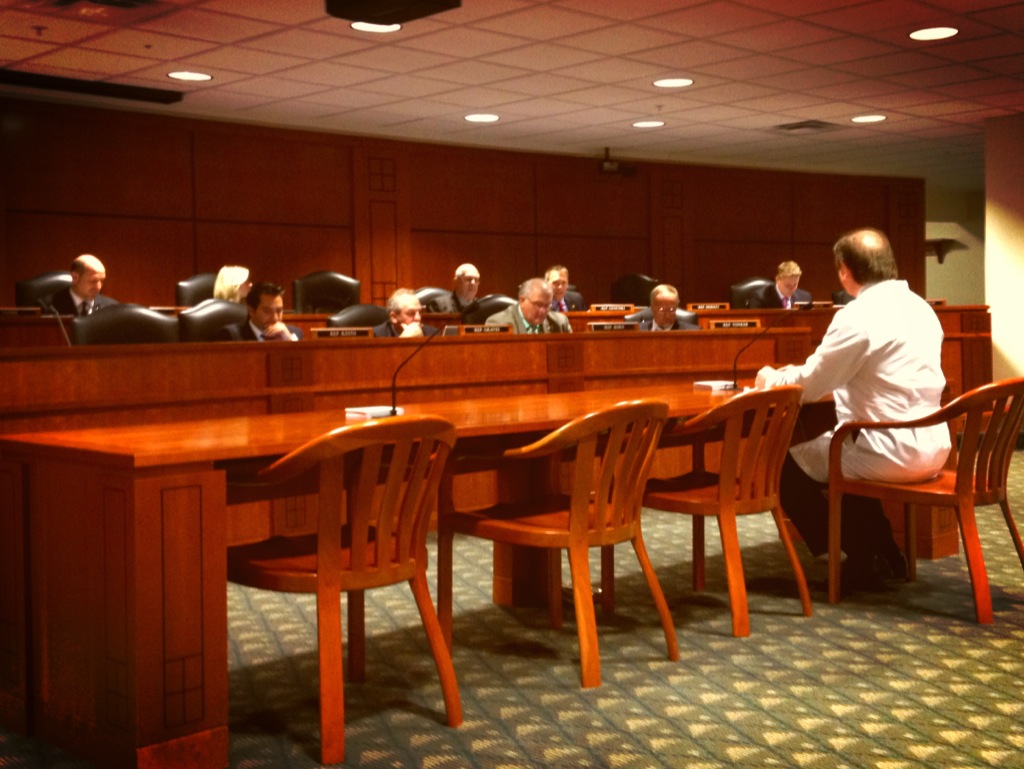
Picture inside committee room for
the No-Fault hearing.
The House Insurance committee takes the award this week with the most active and anticipated committee. House bill 4612 was introduced this week that would provide a major overhaul of the automotive no-fault insurance system that Michigan currently has. As we mentioned last week in the Update, this would provide a cap of coverage for those in a catastrophic accident to $1 Million, provide a pilot program for those looking for low cost insurance and have a low value vehicle, and a major attempt to strike back against fraud. Tempers flared and words were heated between those testifying and member of the committee which boiled over to member to member heated exchanges.

The committee was held in the largest room available to the House for committees and still had four more rooms and hallways full of people wanting to testify and get their voice heard on the issue. The committee went late into the afternoon with the promise that those who wanted to testify could. Finally at the end of the day the committee was not able to get through everyone leaving with more committee meetings to happen here in the near future. MSMS is working with the Coalition Protecting Auto No-Fault (CPAN) in providing information for the committee members on why this is the wrong move for Michigan. We will continue working with our partners to stop this harmful legislation.

Senate:

The senate had more of a mundane week by having them primarily working on their budgets, sending each individual budget to the House for their consideration; a different move from the House that bundled their budgets together. Multiple amendments were made on the floor including the amendment to place the Medicaid expansion money in the Department of Community Health budget, but failed along party lines. With the expansion money still left out it leaves supporters working and pushing for the money to be included. At this point we wait to see the work of the crucial conference committees that will ultimately make the decision on the expansion money.

This week is the MSMS House of Delegates in Grand Rapids. We will be providing an overview of the issues that happened at the annual meeting. Follow MSMS at http://www.msms.org/advocacy to get the up to date information from our Twitter and Facebook feeds. Stay with us as well to get the most up to date information on the issue affecting physicians around Michigan.


Friday, April 19, 2013

Legislative Update Week of April 15th

This week saw a flurry of legislative activity on health issues and other that are big for the medical community, lets get into the review:

House:


Dr. Kenneth Elmassian testifying
to the House Health Policy Committee
This week the House Health Policy committee took testimony on House Bill 4524, the Patient Right to Know legislation. Dr. Kenneth Elmassian, MSMS President-Elect, testified to the committee providing his expertise to the committee on this issue. "It gives patients more information when they are seeking and receiving their health care," Elmassian said. "Let's be honest, the health care system is very confusing. Patients deserve better than the system is currently giving them." The committee members fired back though leaving those in the committee wondering if the legislation would have a hard time getting out. We will be waiting to see what the committee will do in the coming week and we will let you know if the legislation moves further in the process.

Senate:

Dr. Rose Ramirez answering questions
in the Senate Triple R committee.
The Senate Reform, Restructuring, and Reinventing committee this week took its final week of testimony and moved Senate Bill 2 out of the committee to the full Senate Floor for its consideration. We reported before that this legislation would provide a sweeping change to the Public Health code providing independance for NP's CNM's and CNS-C's. For more indepth information on the original bill click on "2" above to obtain bill language and legislative analysis from the Senate Fiscal Agency. Dr. Rose Ramirez, MSMS's Speaker of the House, testified to the committee with her personal professional experience starting out in nursing and then obtaining her MD and working as a physician. "As physicians, our overarching concern is with the well-being of our patients and that the laws and regulations of Michigan lead to health care that is safe, efficient, and of the highest quality.  Patients benefit from having a focused, team-based approach that encourages communication and collaboration among the various members of the team," Dr. Ramirez testified. Through the efforts of the testimony the legislation still made its way out of the committee with a vote count of 6-1.

Budget:

This week saw the Senate Appropriations committee working on their budgets getting them through committee and sent to the full Senate for their consideration. Still left out of the budget was the money for the MSMS supported expansion of Medicaid. Many people around the capitol say that this is a vote that some of the members are either against or uneasy about taking. We could see the budgets get to their final conference committee before a decision is made about the Medicaid expansion.

Auto No Fault:

This week the Governor, along with House and Senate Insurance Chairman, introduced their plan to reform Michigan's Auto No-Fault system. This is round two to a fail attempt last session. That plan created levels of coverage that a individual could purchase that would bring savings to the buyer of the plan. This time around they are taking a different approach by providing a cap for coverage up to $1 Million. Also in the new proposal there will be a pilot program that would provide lower cost insurance for those who in poverty, have a clean driving record, and have a low value vehicle. With this program they are hoping that it will entice those who do not have insurance to purchase it. In terms of fraud they are want to begin an auditor program that will be constantly looking for fraud. With this plan officials say that families with two vehicles could see a yearly savings of $250. 

“Take a good look at this plan: is it really in the public’s best interest? I hardly think so. Capping lifetime benefits at $1 million for the catastrophically injured ultimately will shove the most vulnerable victims onto Medicaid and will pile the financial responsibility to the taxpayers," said John Cornack, President of the Coalition Protecting Auto No-Fault (CPAN). We expect here in the next few weeks that hearings will begin in the appropriate committees.

Stay with MSMS to get the up to date information on twitter @msmsgovtaffairs, on Facebook or online at http://www.MSMS.org/advocacy.

Friday, April 12, 2013

Legislative Update Week of April 8th

Budgets were the word for the legislature this week as the public had the first opportunity to see what the legislature was thinking in funding the government for the next fiscal year. In term of the Community Health budget, Medicaid was put front and center. Let’s review the activities of the past week:

House:

The House this made noise in what was introduced rather than the action that was taken by the body. Representative Gail Haines introduced House Bill 4524 that would require health professionals to wear identification cards so that patients will know who is who. There have been discussions that patients are sometimes confused on who their physician, PA, NP, nurse, etc are; by providing an increased identification hopefully it will provide clarity for the patient and the patient's family.

Dr. Elmassion and Representative Haines
at Patient Right to Know Press Conference.
MSMS hosted a press conference with Rep. Haines and Dr. Kenneth Elmassian, MSMS's President-Elect. They discussed with WLNS the importance of the legislation and the importance of providing clarity to those receiving the care. The House Health Policy committee will be considering the legislation, only taking testimony at their upcoming meeting on April 16th.

The House Health Policy committee has continued their work by furthering their education and knowledge base on the issue effecting Michigan's health care. The topic for this committee meeting was long term care and the effects it is having on insurance carriers. Blue Cross Blue Shield of Michigan along with the Michigan Association of Health Plans testified to the committee providing their insights on the issue of long term care. The committee will be meeting next week to consider several issues including House Bill 4524.

Senate:

The Senate this week considered one piece of legislation that would have direct effects in the medical community, licensure of pharmacy technicians, Senate Bill 92. Currently in Michigan pharmacy techs are not licensed or controlled by the Michigan Board of Pharmacy but rather fall under the purview of the Pharmacist. Because of this, pharmacy techs that are engaged in illegal activities are being let go and then are picked up by another employer where they can continue their illegal activities. By being licensed they now will have to face sanctions and fear of losing a license and having to have a license to practice; it will create a failsafe to keep the bad actors out. This legislation did get through the full Senate and will now be heading to the House Health Policy committee. The Senate Health Policy committee did not meet this past week.

Budget:

This week the Senate subcommittee for the Department of Community Health passed out their recommendation for the upcoming fiscal year. MSMS has been a proponent with the Governor in the Medicaid expansion. Both the House and Senate committees were not so excite about expanding the rolls of Medicaid and left the expansion money out of their budget plans. The Senate did provide language in their bill to ask the federal government to provide a waiver for their program to allow Medicaid to add incentives in the Medicaid program to lead to healthier lifestyles .
Also the committee deciced that restoring funding for Graduate Medical Education would be a priority of the committee. Dr. John Bizon, MSMS President had this to say about it, "By preserving these critical education tools, is is clear that the primary focus of the Subcommittee on the Department of Community Health was imporving the health of Michigan patients for generations and that;s great new for families across our state. Senator John Moolenaar and his colleagues are to be commended for their work on this important issue."

The House, in usual fashion for the past couple years, took all of their budgets and combined them into one massive budget bill. For more information on the House or Senate bills, click on the links provided. With the budgets now out, the legislature has taken one step in what will be many more to come.

For more information on what is happening in Lansing and beyond stay with MSMS at http://www.msms.org/advocacy.

Friday, March 22, 2013

Legislative Update Week of March 18th


With the Educational Achievement Authority leaving those watching the legislature waiting until the end of the week the House signaled that they are not in favor of the Medicaid expansion by leaving money out for those programs with the first movement on the Department of Community Health Budget and the Senate signaling that they aren't interested in working on the money for the exchange, health care is becoming front and center; let’s review the week:

House:

Dr. Kay Watnick speaking to the press
about the tanning legislation.
The House this week took up House Bills 4274 and 4275 that would require interested parties work with the Insurance Commissioner or create a standardized two page prior authorization form for prescriptions. Now the legislation will move to the Senate for their consideration. This week Representative Jim Townsend introduced House Bill 4405 that would restrict the use of tanning beds by minors in Michigan, 16 and under. Kay Watnick, MD, a dermatologists and Immediate Past President of the Michigan Dermatological Society attended a press conference with Representative Townsend at MSMS to discuss the legislation. "Indoor tanning beds emit up to 15 times more ultraviolet rays than what is emit from the sun," said Dr. Watnick. The legislation is referred to the House standing committee on Regulatory Reform.

Senate:

The Senate Health Policy Committee convened this week to consider two items, Senate Bills 136 and 237, 238, and 239. Senate Bill 136 would allow for a conscientious objection to providing certain treatments based on a moral or religious objection by the physician. If there is an emergent situation the physician may not use the objection to not provide treatment. MSMS has worked with the sponsor of the legislation to find a compromise that we feel will be productive for everyone and continue to work with the sponsor. MSMS continues to oppose the legislation. The legislation was sent to the Senate floor for its consideration. Senate Bills 237, 238 and 239 would amend the public health code along with the school code to update the ages needed for vaccinations. The committee took testimony on the issue and is expected to vote out the legislation at its next hearing.

The full Senate considered their version of the prior authorization legislation by passing Senate Bills 178 and 179. These bills will head to the House Health Policy committee for testimony. It is uncertain at this point which legislation will be the final bills passed.

Budget:

The House Appropriations Subcommittee passed it first version of the Department of Community Health budget (House Bill 4213) this week with leaving the Medicaid expansion out of the budget. There were concerns that lawmakers had on the costs to consumers and sustainability of the program with some on the inside asking for reforms to the program before money will be appropriated for the expansion. This is just the first of what will be many more rounds to come. The Senate is expected to pass their version in the coming weeks.

The Health Insurance Exchange it a snag this week in the Senate will the Senate Majority Leader stating that the exchange was virtually dead for the moment. It will be interesting to see what the next moves of the Senate will be with the implementation of the exchange due at the end of this year.

For more information on what is happening in Lansing and beyond stay with MSMS at http://www.msms.org/advocacy. Your voice counts; make it heard by supporting MDPAC! Find more information at http://www.mdpac.org.